
AMD Just Bought an AI Chip That Can Never Be Updated
The AI Model You Have to Manufacture
This one has not been published to the channel yet. Subscribe on YouTube and it will turn up there.
SAME WORK, LESS POWER
- On 6 August 2026 AMD announced it was acquiring Taalas, a Toronto startup that does something no GPU does: it etches an AI model's weights physically into the silicon.
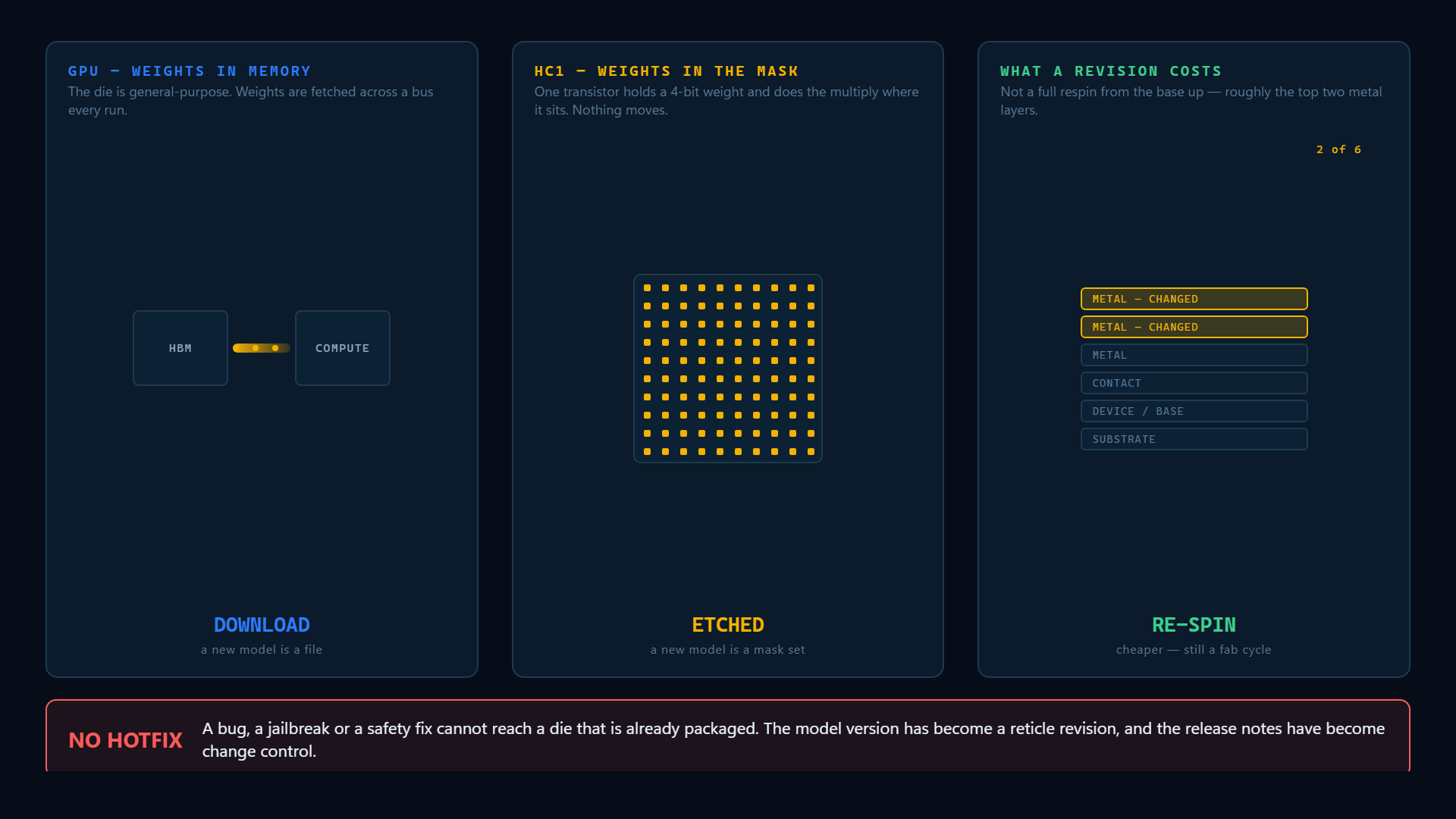
- The weights live in a mask-ROM fabric where a single transistor holds a four-bit value and performs the multiplication in the same place the data sits, so there is no fetching from memory at all.
- The payoff is real — around seventeen thousand tokens per second per user, on a rack drawing twelve to fifteen kilowatts against a hundred and twenty to six hundred for a comparable GPU rack.
- Your model version has quietly become a reticle revision, and your release notes have become change control.
Why this matters
The catch is equally real, and it is a manufacturing catch rather than a computing one: if the weights are in the mask, then updating the model is a mask revision. Roughly two metal layers have to change rather than a full respin from the base up, which is far cheaper than it sounds — but it is still a trip through the fab, and a die that is already packaged cannot be hotfixed for a bug, a jailbreak, or a safety issue.
Keep a prompt changelog. One page, three columns — the date, what you changed, and what the output did. Pin the model version at the top of it. When an answer gets worse you have two suspects: your prompt moved, or the model moved underneath you, and without a log you cannot tell them apart. This is recipe management, and the fab has run it for forty years on exactly one principle — never change the process and the recipe in the same move, because afterwards nobody can say which one did it.
- 0:00A chip that can only run one model
- 0:09Weights in the silicon, not in memory
- 0:19The numbers that make it worth it
- 0:28So what happens when the model changes?
- 0:37Not a download. A trip through the fab.
- 0:42Two metal layers, not a full respin
- 0:49The part you cannot fix
- 1:00Your model version is a reticle revision
- 1:10🔧 Hack of the Week
- 2:02Close
What's the worst thing you've seen shipped that couldn't be patched afterwards?
Argue with me on LinkedIn- AMD Investor Relations, 6 August 2026 — "AMD Acquires Taalas to Advance Compute Solutions for Rapidly Growing AI Inference Market." AMD's own wording: Taalas' technology "optimizes inference dataflows, significantly reducing compute and memory bottlenecks associated with general-purpose architectures," and AMD "plans to integrate the technology into its accelerator roadmap and develop system-level solutions with AMD Instinct GPUs." Vamsi Boppana, SVP of AMD's Artificial Intelligence Group, is quoted. No price disclosed; closing subject to customary conditions and regulatory approvals.
- The Register, 6 August 2026 — "AMD acquires AI chip startup Taalas to boost inference performance by etching models into silicon."
- CNBC, 6 August 2026 — "AMD buys Taalas, startup that hardwires AI models into its silicon."
- EE Times — "Taalas Specializes to Extremes for Extraordinary Token Speed." Technical detail on the mask-ROM recall fabric: a single transistor stores a 4-bit weight and performs the multiplication, with SRAM handling KV cache instead of HBM bandwidth.
- HC1 technology demonstrator: 6nm die, ~53 billion transistors, ~17,000 tokens/second per user (one report gives 16,960); rack power ~12–15 kW versus ~120–600 kW for a comparable GPU rack.
- The re-spin cost: a new model requires roughly two metal layers to change rather than a full base-up respin.
- Landscape, named only to place the tradeoff and not ranked: Etched's Sohu and OpenAI's Jalapeño ASIC make the same fixed-function bargain — throughput and efficiency for a narrower workload.
Full transcript, 287 spoken words
Keep reading
All pieces
OpenAI Just Published the Number Chip Fabs Stopped Trusting in 1986
In this Fabspeak episode: • The figure OpenAI published on 6 September 2026: 3.1 agent-workdays per human workday, an agent-workday being 8 hours of machine runtime; the median researcher using over $600 of inference a day, the top 10% over $7,000. • OpenAI's own caveat: a runtime ratio, not a productivity multiplier.
Your Fab's AI Goes Blind on the 2nm Node — Here's Why
Your fab's new AI spots defects better than any engineer — and on the brand-new node it goes almost blind. Not because the model is bad, but because every one of these systems learns from history: thousands of wafers, labelled defects, known-good outcomes.
An AI Can Now Tell a Chip Factory Machine to STOP — Nobody Agreed Who's Allowed To
There is a public server online right now that hands an AI ten tools for real semiconductor fab equipment. Four of them write — START, STOP, ABORT, and change the process recipe — and it ships with no safety warning.