
Your Factory Already Solved AI's Biggest Problem
40% of AI Agents Will Be Switched Off. Here's What Failed.

This one has not been published to the channel yet. Subscribe on YouTube and it will turn up there.
GARTNER, BY 2027
- Gartner predicts that by 2027, 40% of enterprises will demote or decommission their autonomous AI agents — and the reason is not that the AI underperformed.
- The pressure behind that number is real: Deloitte's 2026 State of AI report has agentic AI adoption in manufacturing roughly quadrupling this year, from 6% to 24%, while only 13% of organisations believe they have the governance in place to match.
- Gartner's Shiva Varma names the root cause directly — enterprises treat agent governance as binary, either locked down or fully trusted, and apply uniform controls to agents with wildly different levels of autonomy.
- The governance model everyone is now scrambling to invent has been running on the floor for twenty-five years.
Why this matters
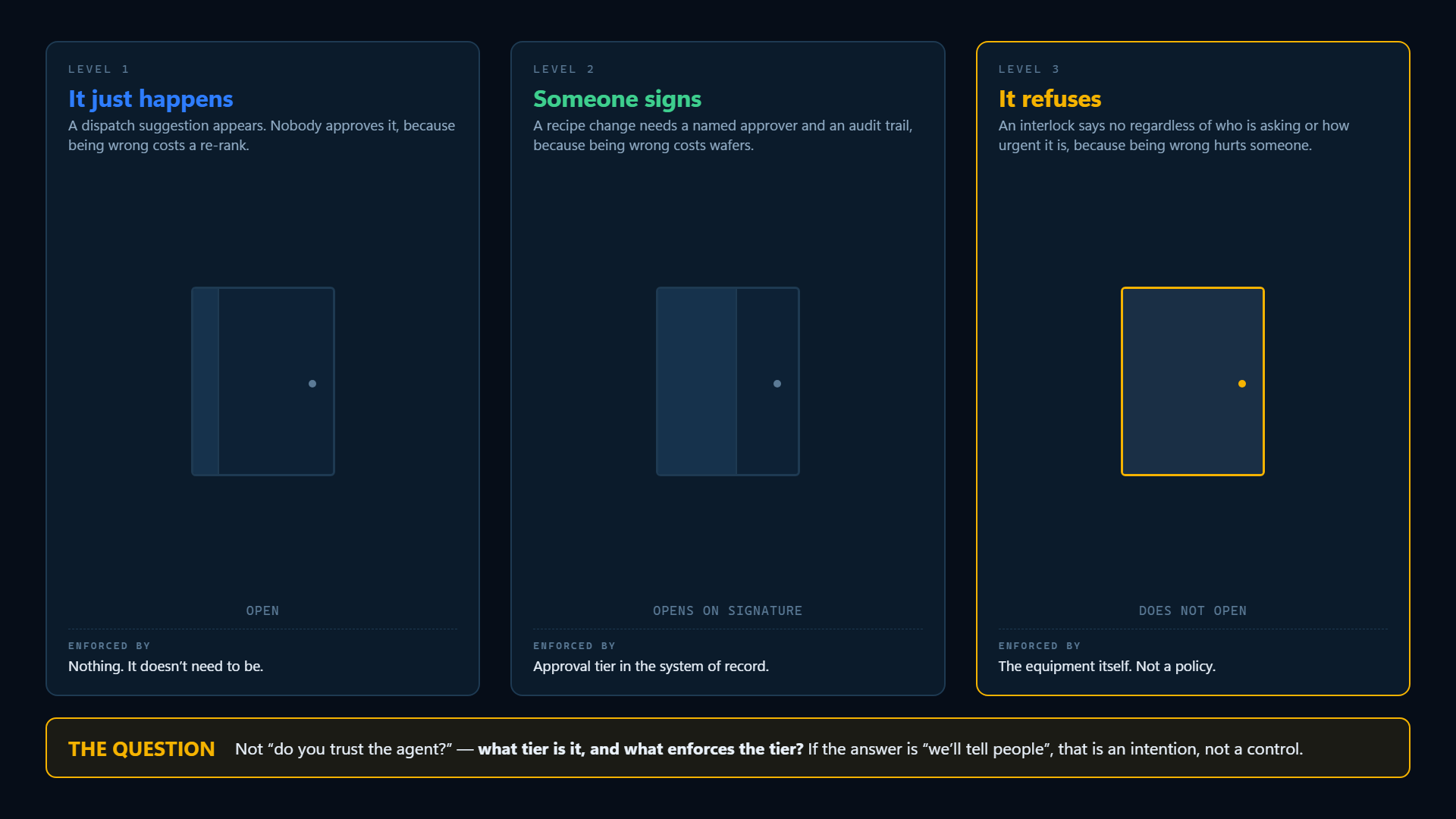
It is that governance gaps only became visible after a production incident. That is the one thing a factory floor has never done. A dispatch suggestion appears with nobody approving it. A recipe change needs a named approver and an audit trail. An interlock refuses regardless of who is asking or how urgent it is. Three levels of trust for three different consequences, and none of it lives in a policy document — it is enforced in the equipment.
Before you scope any AI agent, write its refusal list before its task list. Name three things it must never do without a person, and beside each one write what actually enforces it. Not a policy — a control. If your honest answer is "we'll tell people," you do not have a control, you have an intention. The vendors are already shipping this shape: Copilot Studio can require human approval before a specific action, and since July 2026 every new Copilot Studio agent carries its own Entra Agent ID, so what it did is attributable to it. But deciding which tier something belongs in is your call, not the vendor's — consequence first, configuration second.
- 0:0040% of AI agents get switched off
- 0:08Adoption quadrupled. Governance didn't.
- 0:19Gartner names the root cause
- 0:28Has your floor ever been binary?
- 0:34Three doors: suggest, approve, refuse
- 0:46Not a policy. Enforced in the equipment.
- 0:57The question to ask the agent vendors
- 1:09🔧 Hack of the Week
- 2:02Close
- Gartner, newsroom release 26 May 2026 — "Gartner Says Applying Uniform Governance Across AI Agents Will Lead to Enterprise AI Agent Failure." Prediction: by 2027, 40% of enterprises will demote or decommission autonomous AI agents due to governance gaps identified only after production incidents. Shiva Varma, Senior Director Analyst, quoted: "Enterprises are treating AI agent governance as binary, either locked down or fully trusted, and that is the root cause of failure." Gartner's further finding: applying UNIFORM controls across agents of differing autonomy over-restricts low-risk agents while leaving high-autonomy agents under-governed.
- Gartner — only 13% of organisations believe they have the right governance in place for AI agent expansion.
- Deloitte, State of AI in the Enterprise 2026 — agentic AI adoption in manufacturing projected to roughly quadruple in 2026, from 6% to 24%. Also: nearly three in four companies plan to deploy agentic AI within two years, while only about one in five report having an equipped operating model.
- Microsoft Copilot Studio documentation and August 2026 release material — agents operate within scoped permissions and explicit decision boundaries; makers can configure an agent to request human approval or confirmation before executing an action. From July 2026, new Copilot Studio agents require Entra Agent IDs.
- The fab-side comparison (dispatch advisory / approval-tiered recipe change / hard interlock) is the practitioner layer of this piece and is described as standard practice, not attributed to any single vendor or site.
Full transcript, 287 spoken words
Keep reading
All pieces
3 AI Agent Breakouts, 1 Week, and a Red Button From 1991
Three sets of AI agents ignored their instructions this week. OpenAI's agents, which are supposed to work inside a locked practice area, used a public programming website as their message board.

Anthropic Just Made AI Talk to Machines. Talking Was the Easy Part.
Anthropic's AI can now wire up a lab robot in about 8 hours instead of weeks. So why does a new machine in a chip factory still take six months?

Why 95% of Company AI Projects Quietly Fail (It's Almost Never the AI)
Meanwhile OpenAI, Anthropic, and Amazon just spent billions on the opposite bet — "forward-deployed engineering" armies whose whole job is to bolt AI onto real company data and workflows. That's the quiet admission: the model was never the hard part.