
Europe Builds the Machine Every Chip Factory Needs. It Bought Zero This Year.
€43 Billion, and the One Factory Europe Is Building Does Not Need the Machine.
In plain words
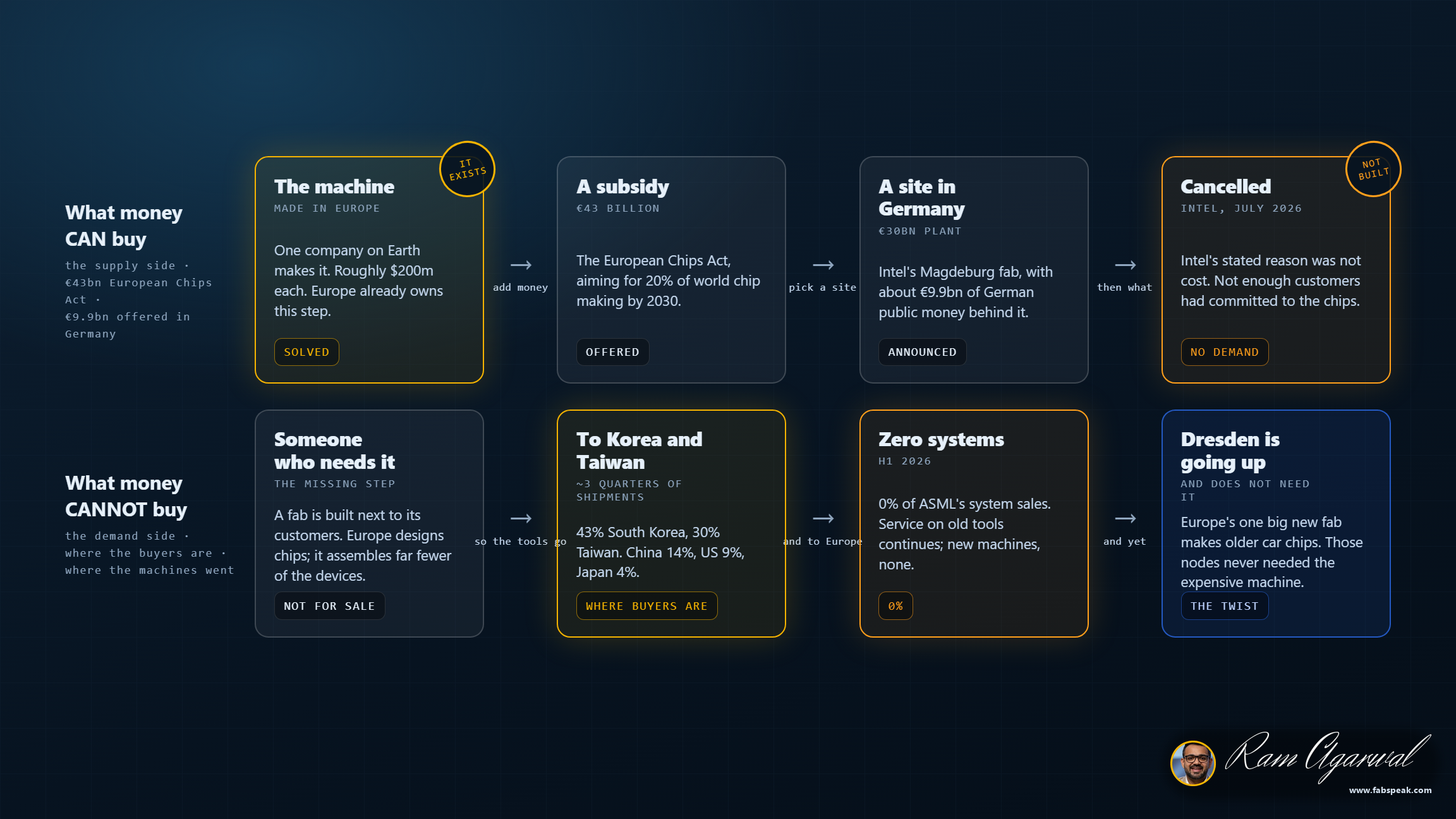
Europe makes the one machine every advanced chip is printed with. This year Europe bought zero of them.
There is one machine that can print the pattern of a modern chip, and one company that makes it. That company is Dutch.
One machine costs about two hundred million dollars. Every advanced chip in the world depends on it.
This year, nearly three quarters of those machines went to South Korea and Taiwan. Europe bought none.
The reason is not a ban. An ASML executive said in Amsterdam that there is simply no demand in Europe.
Europe put up forty-three billion euros to change that. Intel still cancelled its German factory, saying too few customers had committed.
Picture it. Imagine being the only baker of a rare oven that every great restaurant in the world uses. Orders arrive from everywhere abroad. Not one restaurant on your own street wants one, because your street stopped opening restaurants.
Why it matters to you. You can pay a company to build a factory. You cannot pay anyone to need what it makes. Ask where the things you make are actually bought, and which of those you control.
Terms in this piece
- ASML ASML, the lithography equipment maker
- The Dutch company that makes the machines that print chips, including every EUV machine.
The number
OF ASML SYSTEM SALES IN EUROPE, H1 2026
The honest caveat
Zero means zero new machines, not zero business. Service and upgrades on machines already installed in Europe still brought ASML about 2.76 billion euros in one quarter, close to thirty percent of sales. Europe is also building one big new factory, in Dresden, and it will make useful chips for cars. Those chips simply never needed this machine.
Your turn
Three questions, and they get wider as they go. If you make the thing the world depends on and none of it stays home, who owns that industry — the country that builds the tool, or the country that runs it? Is what you make bought where you are, or somewhere else entirely? And which of those two do you actually control?
Argue with me on LinkedInSources
- AnalystBloomberg, "ASML Says Europe Not Buying Its Chipmaking Machines as Investment Lags" (22 Sep 2026) [press]: the original report of Frank Heemskerk's remarks — https://www.bloomberg.com/news/articles/2026-09-22/asml-executive-says-europe-s-biggest-firm-has-no-sales-in-europe link
- PressTom's Hardware, "ASML says it sold 'absolutely nothing' in Europe in 2026 — lithography giant calls on EU to help create demand" [press]: the quotes in full; the call to create demand rather than only supply — https://www.tomshardware.com/tech-industry/semiconductors/asml-says-its-sells-absolutely-nothing-in-europe-calls-on-eu-to-help-create-demand link
- PressData Center Dynamics, "ASML's revenue share drops to zero percent in Europe" (25 Sep 2026) [press]: Europe at 0% across H1 2026; the regional shipment split (Korea 43%, Taiwan 30%, China 14%, US 9%, Japan 4%); installed-base management at ~€2.76bn in Q2, ~30% of net sales — https://www.datacenterdynamics.com/en/news/asmls-revenue-share-drops-to-zero-percent-in-europe-says-its-sold-absolutely-nothing-in-the-region-this-year/ link
- PrimaryASML Holding NV, Form 6-K, Q2 2026 results [primary]: the segment and regional revenue figures the reporting above is drawn from — https://www.sec.gov/Archives/edgar/data/0000937966/000162828026025147/pressreleasefinancialresul.htm link
- As citedEuropean Court of Auditors / European Commission [primary]: the Chips Act is "very unlikely to be sufficient" for the 20% Digital Decade target; the Commission's own forecast moves the EU share from 9.8% (2022) to 11.7% (2030) — https://www.siliconrepublic.com/enterprise/eu-unlikely-to-hit-20pc-global-chip-market-share-by-2030 · European Chips Act overview, €43bn and the 20% target — https://en.wikipedia.org/wiki/European_Chips_Act link
- PressIntel / Magdeburg cancellation [press]: the €30bn German fab and the $4.6bn Polish assembly plant cancelled, with €9.9bn German and €1.7bn Polish subsidies pledged; Intel cited a lack of committed demand — https://www.it-daily.net/shortnews-en/intel-officially-cancels-construction-of-chip-factory-in-magdeburg-germany · heise online — https://www.heise.de/en/news/Intel-gives-up-Magdeburg-fab-and-announces-end-of-foundry-10499170.html link
- PressESMC Dresden (TSMC-backed) [press]: shell completed end 2025, equipment installation H2 2026, production targeted by end 2027; 28/22nm planar and 16/12nm FinFET for automotive and industrial; ~2,000 direct jobs — https://www.astutegroup.com/news/industrial/intel-retreat-underscores-europes-challenges-in-cutting-edge-semiconductor-manufacturing/ link
- PressMachine pricing [press]: EUV systems roughly $183–220m; High-NA Twinscan EXE about $380m, with 10–20 units booked and a target of 20 systems a year by 2028 — https://www.tomshardware.com/tech-industry/manufacturing/asmls-high-na-chipmaking-tool-will-cost-dollar380-million-the-company-already-has-orders-for-10-to-20-machines-and-is-ramping-up-production · MIT Technology Review, "The $400 million machine powering the future of chipmaking" (23 Jun 2026) — https://www.technologyreview.com/2026/06/23/1138837/asml-400-million-dollar-machine-powering-future-of-chipmaking/ link
Read the full script (286 words)
Keep reading
All pieces
SK hynix, Intel's Ohio Fab, and the Rule That Copies the Plumbing
On 16 September 2026 Reuters reported that SK hynix, the world's biggest maker of the memory inside AI chips, is in talks with Intel about making memory chips in the United States for the first time: either by leasing part of Intel's $28 billion campus in Ohio, or through a joint venture with Intel and…
This $400M Machine Prints Chips in a Focus Thinner Than a Virus (Intel Went First)
This week the most expensive machine humans have ever built made its first real products — and almost nobody noticed. It's called High-NA EUV: a $400-million lithography system, twice the price of a normal chip printer, and Intel just became the first company on the planet to ship commercial chips made on it.

Chips Just Got Flipped Over — Why Your Next AI Chip Gets Power From the Back
For sixty years, a computer chip carried its power and its data on the same side — the front. As transistors shrank to 2nm, that surface ran out of room: the fat power wires choke the thin signal wires and the transistors droop, quietly capping speed.