
Every Chip Factory Keeps a Liquid That Would Hurt You. It Is Water.
A Chip Factory Makes the Cleanest Water on Earth. Nobody There Is Allowed to Drink It.

In plain words
Every chip factory keeps a liquid that would hurt you if you drank it. It is water.
Ordinary tap water arrives at the factory and everything is taken out of it: minerals, specks, dissolved gases, bacteria.
Why go that far? Because one grain of salt, dried onto the disc of silicon a chip is built on, is enough to ruin it.
Water that empty is hungry. It pulls minerals out of whatever it touches, so the pipes are a special plastic, and nobody there drinks it.
The rinse time and the purity limit are part of the recipe each machine runs. The software holds a batch at the tool until both are met.
One wafer takes about 8,300 litres of water. TSMC says it keeps 161. A rival, United Microelectronics, has reported recycling above 90% at one plant.
Picture it. It is the difference between the water that passes through a mill wheel and the water the mill actually takes out of the river. One number is enormous and the other is small, and both are true.
Why it matters to you. Both numbers are published and both are true, and they support opposite arguments. If you take one thing from this, take the question: when a figure says how much something used, ask what came back.
Terms in this piece
- TSMC Taiwan Semiconductor Manufacturing Company
- The world's largest contract chip maker; it makes most advanced AI chips.
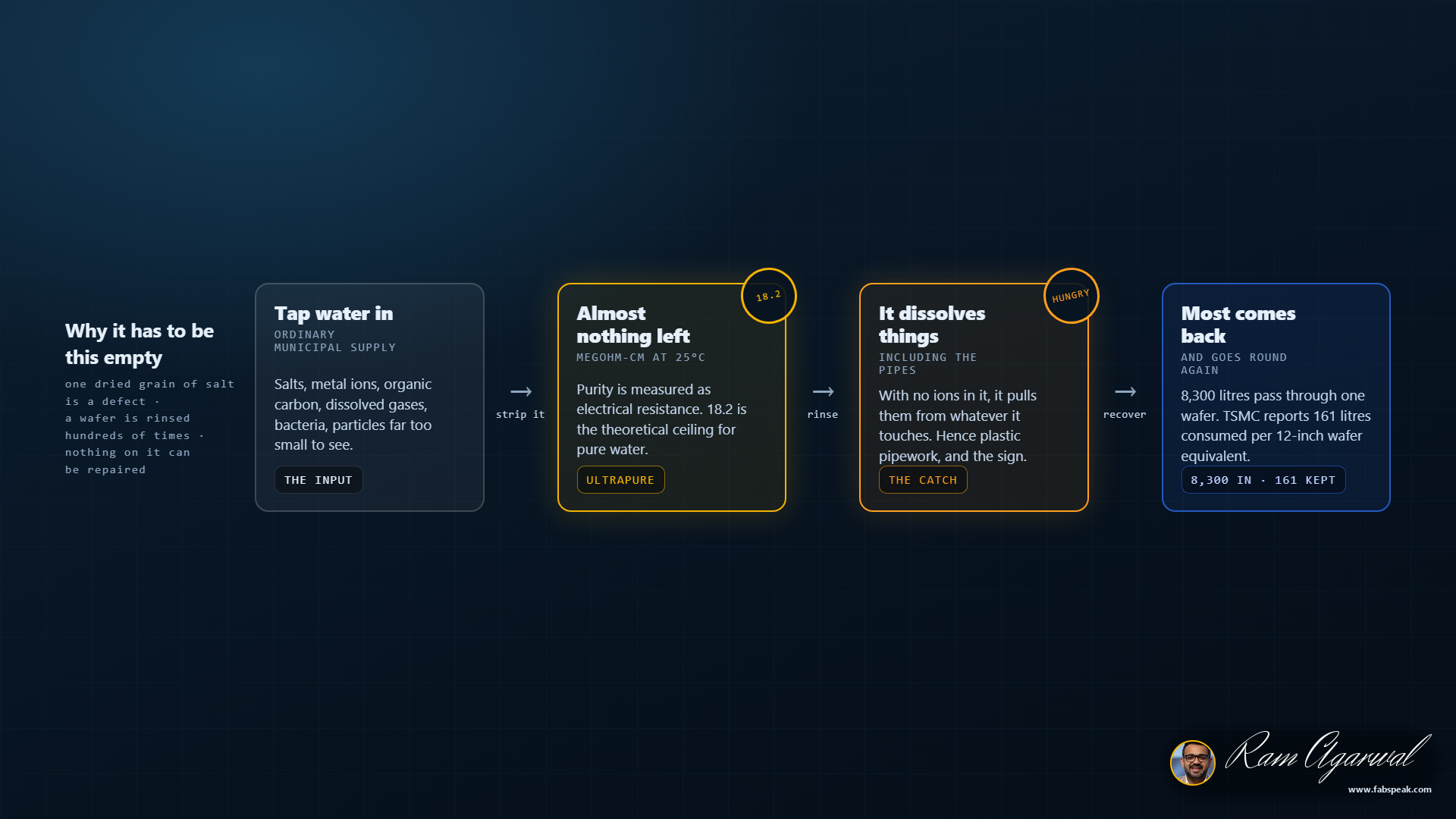
The number
THE PURITY CEILING AT 25C, ELGA 2026
The honest caveat
The two headline numbers measure different things: 8,300 litres is water passing through the process for one wafer, and 161 litres is what TSMC reports as consumed per 12-inch wafer equivalent after recovery. The gap is recycling. Nothing here argues that fabs use too much water or too little, and no company is being praised or criticised; TSMC appears because it publishes the clearest figures.
Your turn
Which number would you have quoted: the 8,300 litres that passed through one wafer, or the 161 that were kept?
Argue with me on LinkedInSources
- PressTSMC 2024 sustainability reporting (published 2025) [primary]: water consumption per unit product of 161.0 litres per 12-inch wafer equivalent, an 8.7% reduction versus 2023; 284.6 million cubic metres recycled through recovery systems; 5.54 million cubic metres of additional water savings - https://esg.tsmc.com/en/focus/greenManufacturing/waterResourceManagement.html link
- PressPer-wafer water intensity (MKS, 2024; Semiconductor Engineering, 2024) [industry reference]: approximately 8,328 litres of water for an integrated circuit on a 300mm wafer, of which about 5,678 litres is ultrapure; cross-checked against the independently reported figure of roughly 2,200 US gallons per wafer with more than 68% ultrapure - https://www.mks.com/n/semiconductor-ultrapure-water/ - https://semiengineering.com/how-semiconductor-fabs-use-water/ link
- PrimaryUltrapure water specification and behaviour (ELGA Lab Water, 2026; Membrane Solutions, 2025) [industry reference]: the 18.2 megohm-centimetre resistivity ceiling at 25 degrees C; why ultrapure water acts as an aggressive solvent and leaches ions from pipework and tissue; why it is unsuitable as drinking water - https://www.elgalabwater.com/ultrapure-water - https://www.membrane-solutions.com/blog-Can-You-Drink-Ultrapure-Water link
- PressDaily fab consumption and the Arizona figures (24 August 2026, and 2026 reporting) [press]: a large fab at several million gallons per day; TSMC Arizona reported at about 4.75 million gallons per day and recycling about 65% of intake - https://ahwatukee411.com/4-75-million-gallons-a-day/ - https://www.azfamily.com/2026/08/24/arizonas-chip-footprint-grows-tsmcs-water-demand-sparks-questions/ link
- AnalystRecycling rates in context (Robeco, March 2026; The Diplomat, September 2024) [analyst / press]: 2023 process water recycling of about 90% at TSMC, with UMC in the mid-80s overall and above 90% at Fab 12a; Taiwan water stress and the 2021 drought - https://www.robeco.com/en-int/insights/2026/03/why-the-future-of-chips-depends-on-water - https://thediplomat.com/2024/09/how-water-scarcity-threatens-taiwans-semiconductor-industry/ link
Read the full script (238 words)
Keep reading
All pieces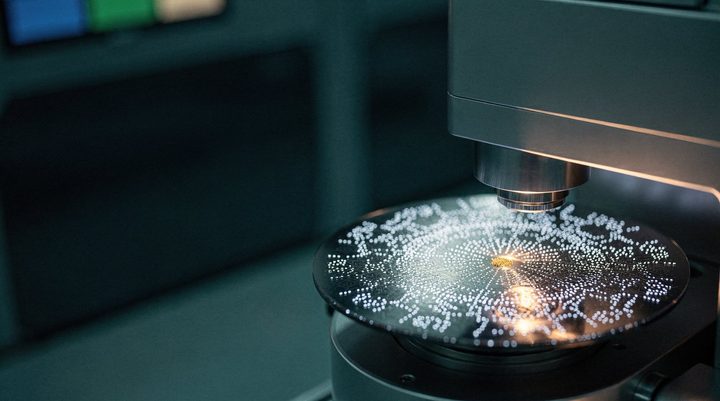
Everyone Is Announcing Capacity. Nobody Is Announcing The Number That Decides It.
Nobody is announcing yield — and only one of those decides whether the wafers are worth selling.
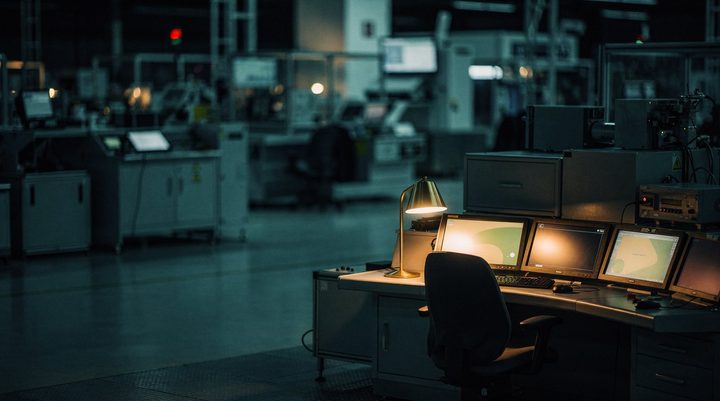
Chip Factories Everywhere. Nobody Left to Run Them.
America is building more chip factories than at any point in its history — and it has 33,000 fewer chip manufacturing workers than it did in 2023. That's not a forecast, it's the Bureau of Labor Statistics: 368,400 people this March, against a peak near 401,000.
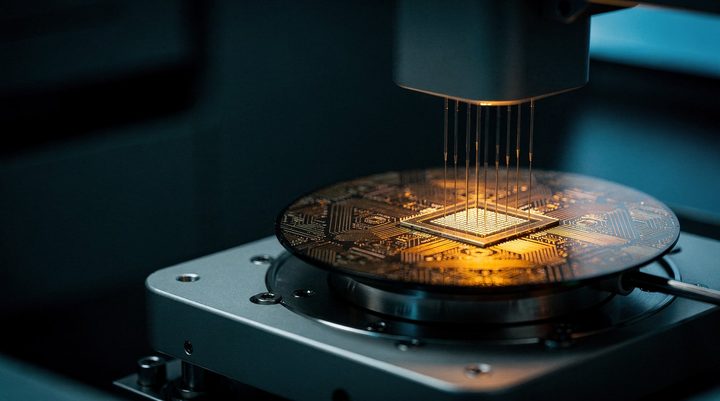
Your Chip Factory Can't Agree Which Die Failed
Every chip on a wafer has an address, and there is a standard for writing it down: SEMI E142, the specification for substrate mapping. The problem is that wafer test data mostly doesn't use it — the XY coordinates coming out of a prober depend on the prober and the recipe combination, and probably don't…