
A Record $403 Billion Quarter — And Nobody Made More Chips
The Chip Industry's Best Quarter Ever Wasn't About Chips
SIA · 6 AUGUST 2026
- On 6 August the Semiconductor Industry Association reported the biggest quarter the chip business has ever had: $403.3 billion in Q2 2026, up 35.1% on Q1, with June alone at $134.5 billion — 123.6% above June last year.
- The world's factories did not get 35% bigger.
- Installed capacity grows roughly 6.6% a year on SEMI's numbers, and a new fab takes about 36 months to build and 36–60 months from groundbreaking to real volume — roughly 18 months of facility work, a year of cleanroom outfitting, and another year moving in and calibrating tools.
- So if revenue moved 35% in three months and capacity moved about 6% in twelve, the difference has to come from somewhere else: price, product mix, and inventory drawn down.
Why this matters
The part that got almost no coverage is what did *not* happen. Those two clocks are nowhere near each other. It is the same thing that happens to a restaurant that suddenly takes 35% more bookings with the same kitchen — it raises prices, pushes the expensive dishes, and empties the store cupboard, because a new kitchen takes three years. None of this makes the SIA's number wrong; it is a real, accurately reported number.
It just isn't a number about factories. And if you have worked in a fab you already know the uncomfortable version: the quarter you are shipping now was decided two or three years ago, when somebody signed for a building.
In Microsoft 365 Copilot you can build an agent with no code and submit it to your organisation's Agent Store, where an admin reviews and approves it before anyone uses it — it then appears to everybody under "Built by your org," discoverable with governance attached. Agent Builder will also take a SharePoint list directly as a knowledge source, so a spec table, parts list or shift log can back the agent without moving the data anywhere. If you work near a plant this is a shape you already know: it is document control. A spec is written, reviewed and released before it reaches the line, because eleven private copies of a procedure at four different revisions is how a process quietly gets lost. So build the one everybody rebuilds badly — the status roll-up, the checklist, the handover note — submit it, let it be approved once, and the whole organisation works from one version. If you are on Copilot Studio rather than the M365 side, the closely related move is run-only agent sharing (preview from August 2026, general availability January 2027): colleagues can run an agent but cannot edit it.
- 0:00A record $403.3 billion quarter
- 0:10What nobody said next: the factories didn't grow
- 0:28The restaurant with the same kitchen
- 0:42Price, mix and inventory — not more silicon
- 0:48The quarter you ship was decided three years ago
- 1:02$1.5 trillion is real. It isn't about factories.
- 1:13🔧 Hack of the Week: get it approved once (M365 Agent Store)
When a number at your company jumps, who actually asks what it's made of?
Argue with me on LinkedIn- Semiconductor Industry Association, announced 6 Aug 2026 — Q2 2026 global semiconductor sales $403.3bn, +35.1% vs Q1 2026; June 2026 $134.5bn, +123.6% YoY; SIA President & CEO John Neuffer expects 2026 to exceed $1.5 trillion. Regional June YoY: Americas +160.9%, Asia Pacific +124.4%, China +112.8%, Europe +75.2%, Japan +39%.
- SEMI — installed capacity growing ~6.6% per year toward 33.6 million wafers/month; 18 new fabs began construction in 2025, most starting operations 2026–27; global equipment spending ~$152bn in 2026 (+24%), ~$166bn in 2027.
- Fab build timeline — ~36 months typical; 36–60 months groundbreaking to volume production; capital cost above $20bn. Phases: facility ~18 months, cleanroom outfitting ~12, equipment move-in and calibration ~12.
- Microsoft 365 Copilot — Agent Builder submissions to the Agent Store under "Built by your org" via admin review in the M365 Admin Center; Agent Builder also supports a SharePoint list as a knowledge source. Microsoft Copilot Studio — run-only agent sharing ("Share Autonomous Agents to End Users"), preview from August 2026, general availability January 2027. No vendor endorsed. The SIA's figure is accurately reported and the video says so explicitly.
Full transcript, 289 spoken words
Keep reading
All pieces
Chip Factories Everywhere. Nobody Left to Run Them.
America is building more chip factories than at any point in its history — and it has 33,000 fewer chip manufacturing workers than it did in 2023. That's not a forecast, it's the Bureau of Labor Statistics: 368,400 people this March, against a peak near 401,000.
OpenAI Just Published the Number Chip Fabs Stopped Trusting in 1986
In this Fabspeak episode: • The figure OpenAI published on 6 September 2026: 3.1 agent-workdays per human workday, an agent-workday being 8 hours of machine runtime; the median researcher using over $600 of inference a day, the top 10% over $7,000. • OpenAI's own caveat: a runtime ratio, not a productivity multiplier.
Your Chip Factory Can't Agree Which Die Failed
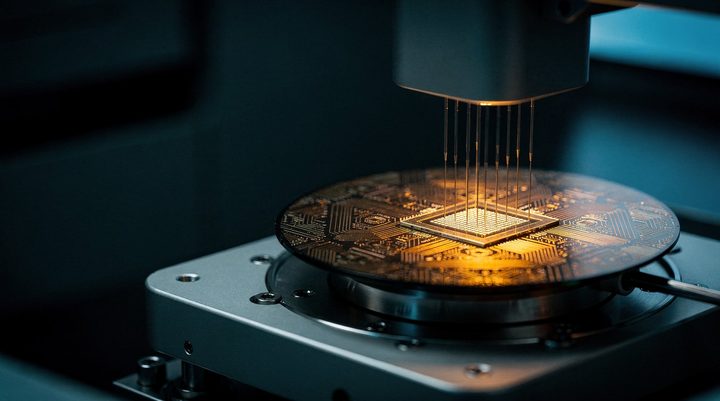
Every chip on a wafer has an address, and there is a standard for writing it down: SEMI E142, the specification for substrate mapping. The problem is that wafer test data mostly doesn't use it — the XY coordinates coming out of a prober depend on the prober and the recipe combination, and probably don't…