
AI Ate Your RAM — And There Was Never a Shortage
Your RAM Doubled in Price. Nobody Stopped Making It.
PER GIGABYTE
- Your RAM got about twice as expensive this year, and the reason has almost nothing to do with a shortage — the memory fabs are running flat out at record output, with $52B going into 300mm memory equipment in 2026 alone, up 29%.
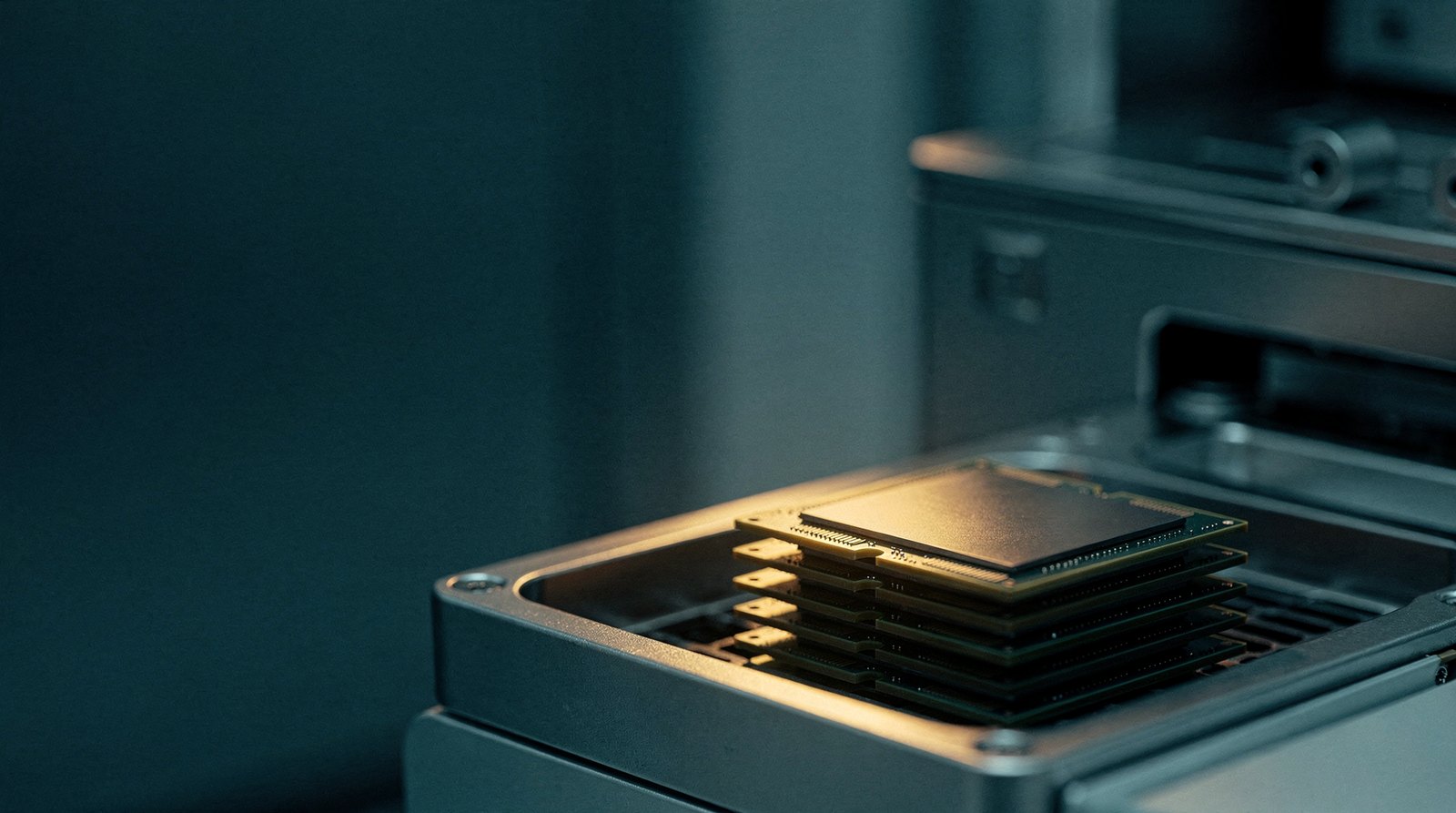
- What actually happened is a reallocation, and it comes down to physics: a gigabyte of the high-bandwidth memory AI needs costs roughly 3× the wafer area of the DRAM in your laptop, because HBM is stacked twelve chips tall and you have to drill thousands of vias straight through the silicon — and the keep-out space around every one of those vias eats the density, leaving ordinary DRAM about 85% denser.
- Then stack yield compounds against you: twelve layers at 99% each doesn't give you 99%, it gives you 87%, on top of 40–60% more process steps.
- So AI memory went from 8% of all DRAM wafers in 2024 to 23% this year, while total capacity grew about 2%.
Why this matters
From the factory side the punchline is simple and it's the thing consumer coverage keeps missing: capacity was never chips, it's wafer starts — nobody stopped making your RAM, the wafers it used to live on are just making something else.
The model market just split in two — DeepSeek shipped a small, cheap model that's genuinely good, while GPT-5.5 added a mode that deliberately spends MORE compute on hard problems. So the question stopped being "which model is best" and became "am I routing, or defaulting?" Paste your recurring AI tasks into Copilot, Claude or ChatGPT and have it sort each one by what it ACTUALLY requires: frontier (real multi-step reasoning over state that won't fit in one prompt), mid, or cheap/small (summarize, extract, classify, reformat, translate). Tell it to be strict — "it's important" is not the same as "it needs frontier reasoning." When I ran it on 10 tasks, 6 came back as cheap-model work, and those 6 were the highest-volume ones. Importance wasn't the axis. Reasoning depth was.
- 0:00Your RAM doubled — and it isn't a shortage
Do RAM prices come back down before 2028 — or is this the new baseline?
Argue with me on LinkedIn- HBM ≈3× the wafer capacity of DDR5 per GB — Tom's Hardware
- SK hynix D1z DDR4 0.296 Gb/mm² vs HBM3 0.16 Gb/mm² (~85% denser), driven by TSV keep-out — SemiAnalysis / Damnang
- +40–60% process steps for HBM vs standard DRAM — HBM/hybrid-bonding engineering sources
- Stack-yield compounding: 99%^8 ≈ 92%, 99%^12 ≈ 87%
- HBM share of DRAM wafers: 8% (2024) → 23% (2026)
- 300mm memory capacity 4.1M → 4.2M wafer starts/month (~+2%) — SEMI 2Q26 300mm Fab Outlook
- SEMI: memory equipment spend $52B in 2026, +29%
- DRAM pricing +60% in 2025, +30–40% in 2026 No vendor endorsed; Samsung / SK hynix / Micron named only to describe the landscape.
Full transcript, 309 spoken words
Keep reading
All pieces
The Chip So Big They Can't Throw the Broken Part Away
Every chip factory on Earth runs on the same rule: cut the wafer into hundreds of chips, test them, and throw the broken ones away. That rule is what "yield" means.
Your Chip Factory Can't Agree Which Die Failed
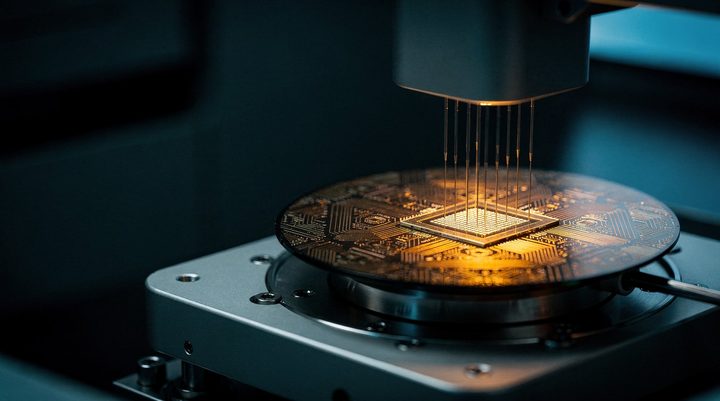
Every chip on a wafer has an address, and there is a standard for writing it down: SEMI E142, the specification for substrate mapping. The problem is that wafer test data mostly doesn't use it — the XY coordinates coming out of a prober depend on the prober and the recipe combination, and probably don't…

NVIDIA Is Replacing the Wires Inside AI With Light — Here's the Real Catch
Inside a giant AI system, just moving the data between chips can burn more power than the computing itself — so NVIDIA is doing something wild: replacing the copper wires with light. In this video I break down co-packaged optics (the "light engine" built right into the chip package), why copper hit a hard power…