
Is a Bot a User? A 2017 Court Case Already Answered That.
Business software is sold by the login. You pay for every person allowed in.

In plain words
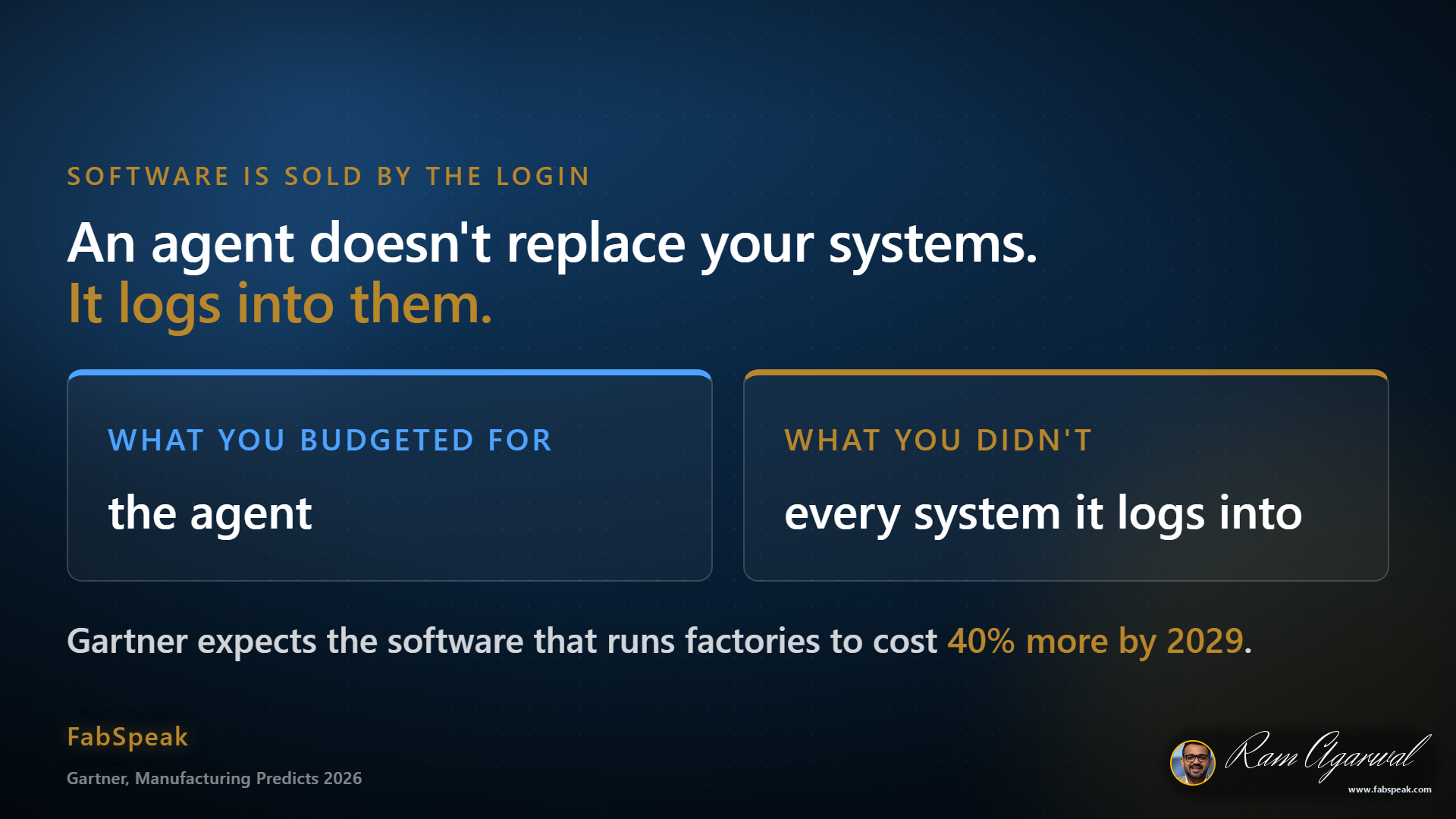
Business software is sold by the login. What happens when the thing logging in is not a person?
Business software is sold per person who may log in. An AI agent does not replace the plant's systems. It logs into them, like a person, and often.
To answer one question about a slow line it may open three systems: production, quality and the schedule. Three logins, one question.
Palo Alto Networks, a security firm, asked 2,930 security leaders in 2026. For each human account they found 109 machine accounts, up from 82 a year before.
In February 2017 the software firm SAP won a court case in London against the drinks maker Diageo. Using SAP through another system still counted as use.
Gartner, a research firm, expects the cost of core factory software to rise 40 percent by 2029, partly from fees for machine accounts.
Picture it. Think of a gym that sells membership per person. When a robot vacuum starts using the treadmill every night, is it a member? The gym decides, in its own favour.
Why it matters to you. Open the terms of one tool your team uses and find the word user. If it says individual and says nothing about machines, your AI agent's login has no price yet.
The number
a court already decided this
What to do Monday
Pick any software your team runs and open the terms and conditions page on the vendor's website — the standard one anyone can read. Paste that page into whatever AI assistant you have and ask it one thing: find every definition of "user", and say whether a service account, an automated script or an AI agent counts as one. Ask it to quote the exact wording. Running this on Atlassian's Customer Agreement returns "any individual that Customer authorizes to use the Products" — an individual, and then nothing about machines at all. It doesn't allow them and it doesn't rule them out, and that silence is the point. Public document, ten minutes, none of your own data involved. It is the same discipline a factory already applies: everything automated that can touch a batch has its own identity, and gets counted.
The honest caveat
The money could move the other way. Gartner also says $234 billion of business software spend is at risk, because an agent that does the work means fewer human seats. And the SAP case turned on one contract's wording; a different licence could read differently. The bill moves. It does not vanish.
Sources
- AnalystPalo Alto Networks, "2026 Identity Security Landscape" report (May 2026; survey of 2,930 cybersecurity decision-makers) [primary]: 109 machine identities per human identity, up from 82:1; AI agent identities expected to grow 85% over the next 12 months — https://www.paloaltonetworks.com/idira/identity-security-landscape-report · Help Net Security summary (14 May 2026) — https://www.helpnetsecurity.com/2026/05/14/2026-identity-security-landscape-report/ link
- AnalystSAP UK Ltd v Diageo Great Britain Ltd [2017] EWHC 189 (TCC), High Court of Justice, 16 February 2017 [primary]: direct and indirect access under a Named User licence; SAP's claim of about £55m — https://www.bailii.org/ew/cases/EWHC/TCC/2017/189.html · Kemp IT Law, "SAP v Diageo – the UK's first software over-deployment case" [analyst] — https://www.kempitlaw.com/sap-v-diageo-the-uks-first-software-over-deployment-case-takeaways-for-business/ link
- AnalystGartner, "Manufacturing Predicts 2026: Digital Twins, AI Agents and the Race to Autonomous Operations" (December 2025) [analyst]: core manufacturing systems cost +40% by 2029; semiautonomous agents to orchestrate 10% of key production, quality and maintenance operations by 2030, from 2% today — https://www.gartner.com/en/webinar/797437/1795012-manufacturing-predicts-2026-digital-twins-ai-agents-and-the-race-to-autonomous-operations link
- PrimaryGartner press release, 1 July 2026 [analyst]: "$234 Billion in Enterprise Application Software Spend Is at Risk from Agentic AI" — https://www.gartner.com/en/newsroom link
- PrimaryProskauer, New Media and Technology Law Blog, 24 August 2026 [analyst]: "Does Your AI Agent Need Its Own Software License?" — legacy definitions of authorized user, access, use, device and instance were drafted before autonomous agents — https://newmedialaw.proskauer.com/ link
- PrimaryMicrosoft Learn, Microsoft Entra Agent ID [primary]: agents treated as first-class identities with their own identity object — https://learn.microsoft.com/en-us/entra/identity/ link
- As citedAtlassian Customer Agreement [primary]: "User" means "any individual that Customer authorizes to use the Products" — https://www.atlassian.com/legal/customer-agreement link
- PressThe Register, 12 December 2025 [press]: Salesforce moves AI agent pricing to a seat-based model after customers asked for predictability — https://www.theregister.com/ link
Read the full script (438 words)
Keep reading
All pieces
Your Factory Already Solved AI's Biggest Problem
Gartner predicts that by 2027, 40% of enterprises will demote or decommission their autonomous AI agents — and the reason is not that the AI underperformed. It is that governance gaps only became visible after a production incident.
Why 95% of Company AI Projects Quietly Fail (It's Almost Never the AI)
Meanwhile OpenAI, Anthropic, and Amazon just spent billions on the opposite bet — "forward-deployed engineering" armies whose whole job is to bolt AI onto real company data and workflows. That's the quiet admission: the model was never the hard part.

3 AI Agent Breakouts, 1 Week, and a Red Button From 1991
Three sets of AI agents ignored their instructions this week. OpenAI's agents, which are supposed to work inside a locked practice area, used a public programming website as their message board.