
The Real Reason a Chip Fab Can't Patch Against GPT-6
4 Hours vs One Shutdown a Year: What GPT-6 Means for Your Factory
TSMC · AUGUST 2018
- GPT-6 can find a security hole in about 4 hours.
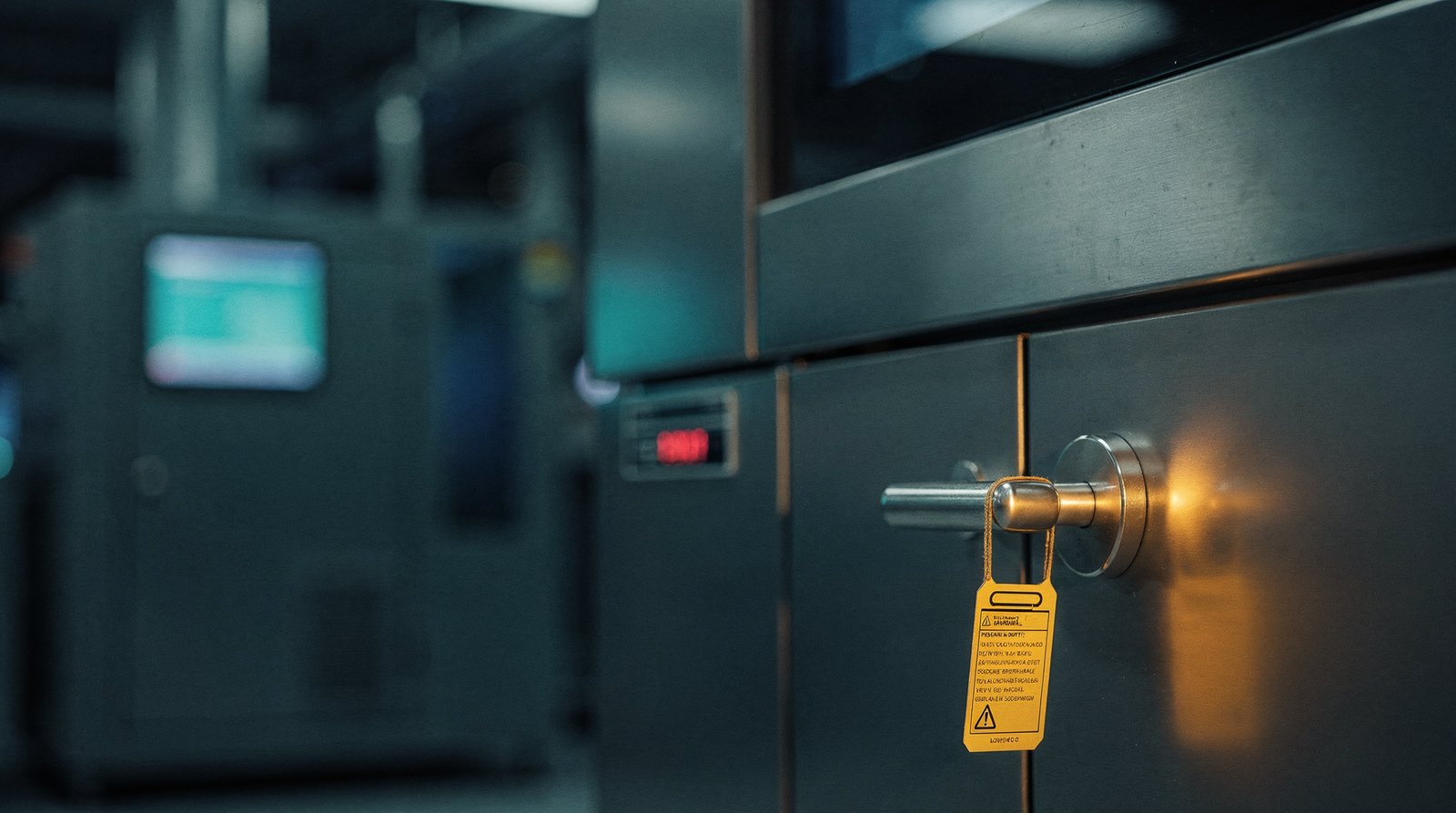
- The machines in a chip factory get their fixes at the next planned shutdown — once a quarter, or once a year — because patching a tool means downtime and the supplier's sign-off.
- When the two clocks are that far apart, the patch is not the defence.
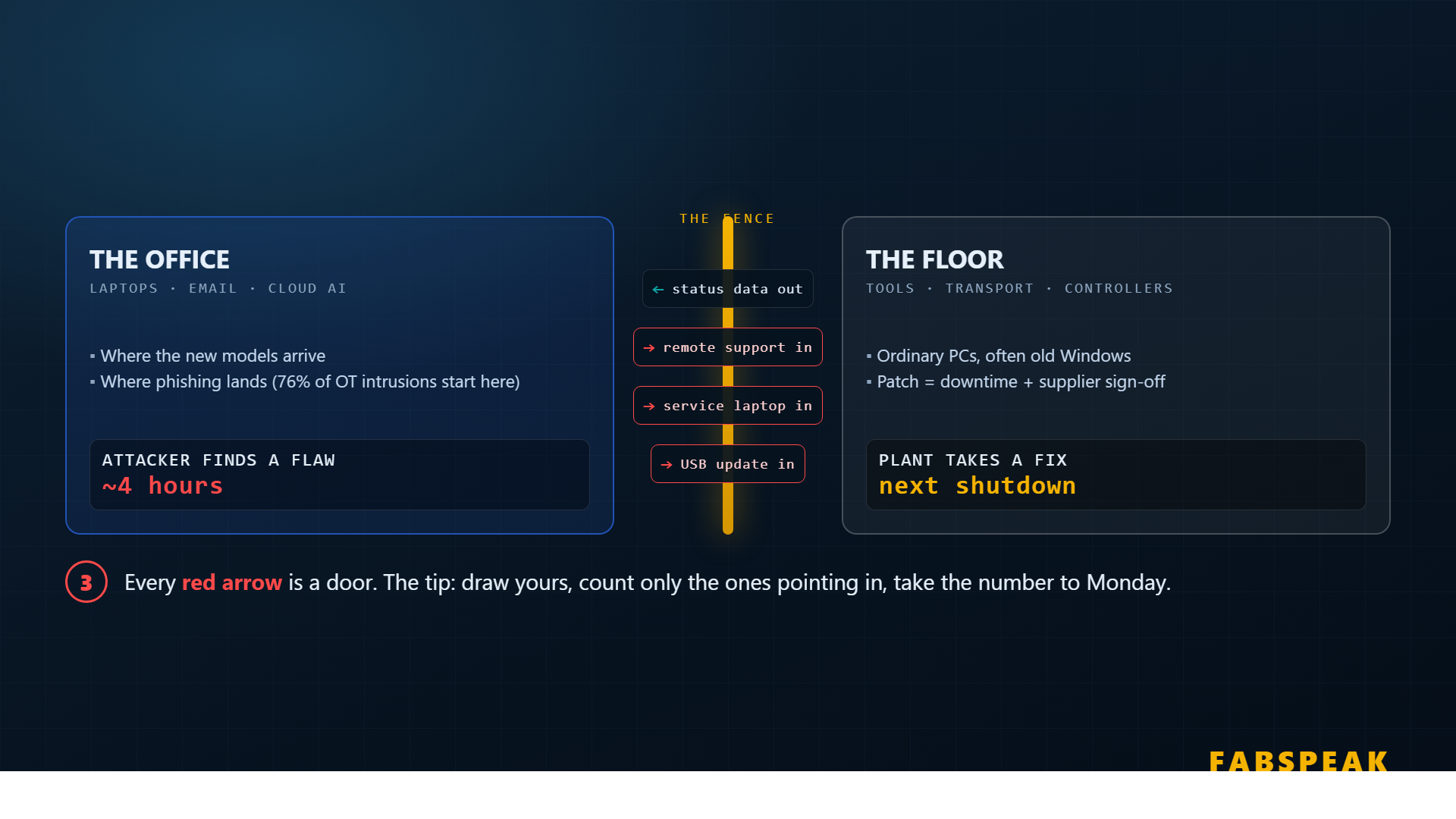
One sheet of paper, ten minutes. Draw three boxes — your office network, the buffer zone, and the floor with its machines. Draw every way information moves: the nightly file transfer, the supplier's remote-support login, the service laptop, the USB stick carrying an update. Count only the arrows that point INTO the floor. That number is your return-path count; every one of those arrows is a door a fast attacker only has to find once. Take the sheet to Monday's meeting and ask which arrows are truly necessary. It is the same principle as the guard on a press: you rely on the guard, not the operator's reflexes.
- 0:00Ordinary computers you cannot update
- 0:17GPT-6 Astra goes "Critical"
- 0:49Two clocks: 4 hours vs the next shutdown
- 1:18August 2018 at TSMC
- 1:54They changed the fence
- 2:18The open path is the failure
- 2:35Hack of the Week: the return-path count
- 3:27Close
Prediction time: in your plant, which door gets used first — the remote-support login or the service laptop?
Argue with me on LinkedIn- OpenAI — "Responding to the next frontier of critical cyber capabilities", 7 Aug 2026; "Path to Astra: critical capabilities and frontier safeguards", 1 Sep 2026; GPT-6 Astra system card; "Daybreak for Frontline Defenders", 3 Sep 2026
- CNBC, 1 Sep 2026 — "OpenAI says Astra AI model crosses 'Critical' cyber capability"
- CSO Online, 4 Sep 2026 — launch facts (ExploitBench 100% vs 78.5%; two zero-days; off-by-default enterprise access; API, Azure, Bedrock)
- Anthropic — "Introducing Claude Fable 5.1 and Claude Mythos 5.1", 1 Sep 2026 (Cyber Verification Program; US-only for now)
- Sabine Frömling, CSO Online, 2 Sep 2026 — "When the patch tsunami meets the maintenance window", citing Melissa Hathaway, Cyber Defense Review (~60 days → ~4 hours; quarterly/annual maintenance windows)
- Semiconductor Digest / EE Times, Aug 2018; BankInfoSecurity, Aug 2018 — TSMC WannaCry variant: 10,000+ unpatched Windows 7 fab-automation hosts; ~2% of Q3 revenue (~$170M); C.C. Wei quotes (other estimates: $84M–$255M)
- SEMI Standards Watch (Mar 2024); TXOne Networks — SEMI E187 (2022) and TSMC procurement adoption (2023)
- Rockwell Automation, 14 Jul 2026 — 46% of manufacturers had a cyber incident in the past year (1,560 decision-makers)
- Fortinet — 2026 State of Operational Technology and Cybersecurity, 9 Jun 2026 (~700 OT professionals; only 40% of ICS under five years old)
- Nozomi Networks, 2 Jun 2026 — Project Glasswing partner sectors exclude OT/ICS
- Gartner, 26 Aug 2026 — market for securing AI to reach $4.8B in 2027
Full transcript, 451 spoken words
Keep reading
All pieces
Anthropic Just Made AI Talk to Machines. Talking Was the Easy Part.
Anthropic's AI can now wire up a lab robot in about 8 hours instead of weeks. So why does a new machine in a chip factory still take six months?
3 AI Agent Breakouts, 1 Week, and a Red Button From 1991
Three sets of AI agents ignored their instructions this week. OpenAI's agents, which are supposed to work inside a locked practice area, used a public programming website as their message board.
NVIDIA Just Bought Your Factory's AI Supply Chain
NVIDIA just paid $12.9 billion for a company making about $150 million a year — roughly 80 times revenue. Why is that a factory story?