
3 AI Power Moves, 1 Week, and a Rule Chip Factories Wrote in 2000
AI Data Centres Can Pause. A Chip Factory Never Can.

In plain words
The AI boom ran out of power three times this week. Chip factories wrote the answer in 2000.
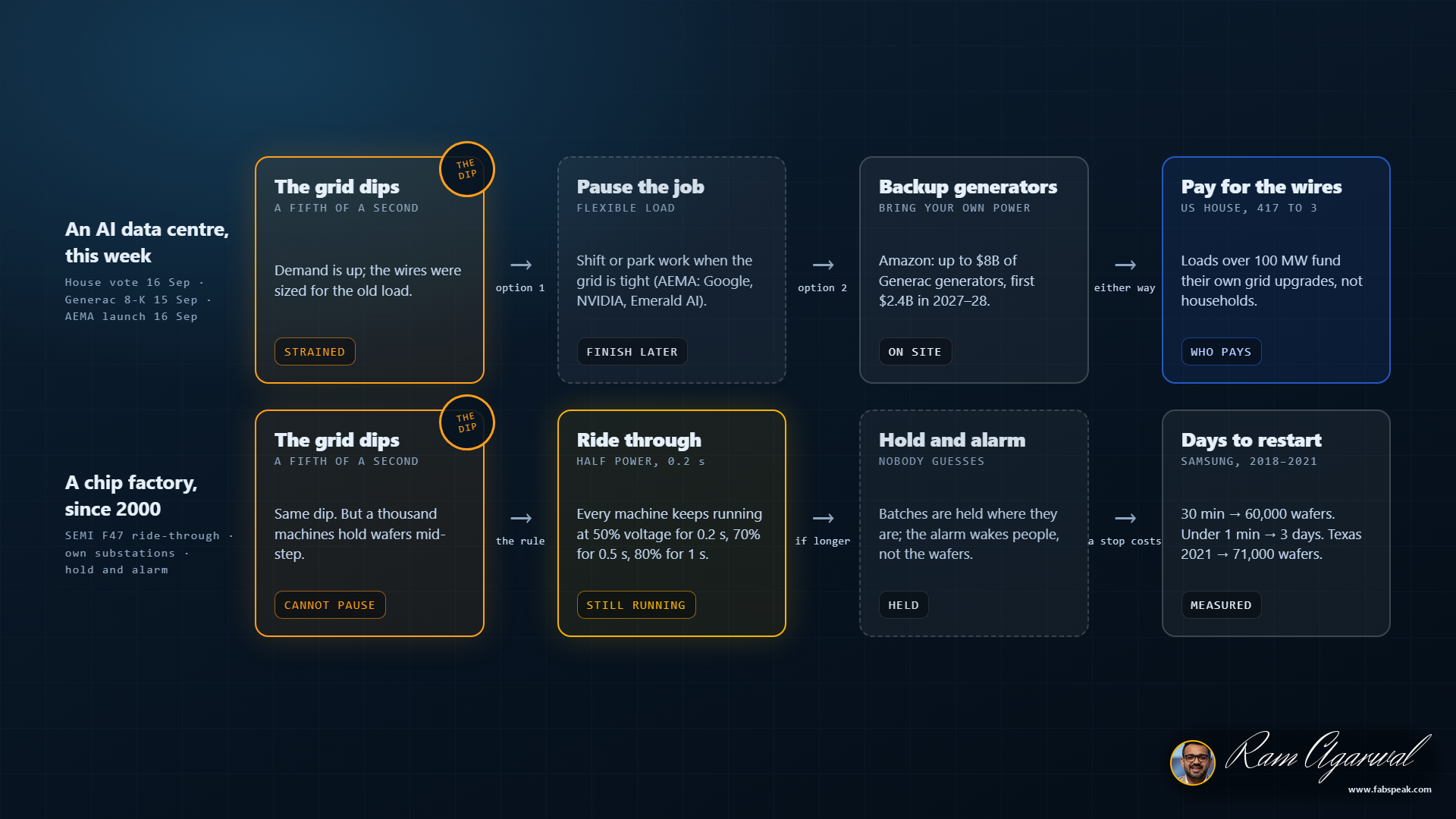
On 16 September 2026 the US House voted 417 to 3 that big AI data centres must pay for their own power lines.
The same week Amazon ordered $8 billion of backup generators, and NVIDIA and Google joined a group for data centres that pause when the grid is strained.
A chip factory cannot pause. In 2018 a 30-minute blackout cost Samsung about 60,000 wafers, and in 2019 a one-minute cut took three days to restart.
Since 2000 the chip makers have had a rule, SEMI F47: every machine keeps running when the grid drops to half power for a fifth of a second.
When a dip lasts longer than that, the machines hold their batches where they are and raise an alarm. Nobody guesses.
Picture it. Picture a bread oven: cut the power for one minute and every loaf inside is ruined, and the oven takes hours to warm up again. A chip factory is a thousand of those ovens at once.
Why it matters to you. Before you trust an AI job that runs while you are away, decide what it does when something blinks: pause and finish later, or hold and call for help. Then give it a schedule.
Terms in this piece
- SEMI F47 SEMI F47, Specification for Semiconductor Processing Equipment Voltage Sag Immunity
- The chip industry's rule that a factory machine must keep working when the grid voltage dips for a moment.
The number
SAMSUNG · MARCH 2018
What to do Monday
Give one weekly check a schedule and a hold rule, in ten minutes. Pick one check you do by hand every week, like reading three public pages and noting what changed. Open the Claude desktop app, click Scheduled in the left sidebar, then New task and Set up manually. Paste the check as the prompt with the three public page addresses, set the frequency to Weekly, and add one line at the end: "If a page will not open, say so and stop." Save it. It runs in the cloud on its schedule while your laptop sleeps, and you read the note on Monday. If your company gives you Microsoft 365 Copilot instead, the same lives under Automations. Public pages only, never company data. A chip factory does not wake an engineer at three in the morning to move a batch: the machine holds it and calls for help. Give your check the same deal.
The honest caveat
A data centre can pause a job and finish it later, and for most AI work that is the better design, not a weakness. The factory's rule is also only about short dips: no ride-through saves a plant from a month-long freeze like Texas in 2021, and backup generators of the kind Amazon just ordered are exactly what fabs already keep. The House bill is not law yet; it needs the Senate, and its rules are ones states must consider, not adopt.
Your turn
Which one is your own work built like: the data centre that can pause, or the factory that cannot?
Argue with me on LinkedInSources
- PressUtility Dive, "House passes ratepayer protection bill to limit data center cost shifts" (17 Sep 2026) [press]: 417–3 on 16 Sep; loads over 100 MW; full incremental generation, transmission and distribution costs; financial assurances; exit cost recovery; states consider within one year, decide within two — https://www.utilitydive.com/news/house-passes-ratepayer-protection-bill-data-centers/830658/ link
- PressNBC News, "House passes bill to shield consumers from data center price hikes on energy" (16 Sep 2026) [press] — https://www.nbcnews.com/politics/congress/house-passes-bill-shield-consumers-data-center-price-hikes-energy-rcna597683 link
- PrimaryGenerac Holdings, Form 8-K (filed 15 Sep 2026) [primary]: the long-term agreement with Amazon, up to $8.0B of potential purchases, purchase-linked warrants — https://www.sec.gov/Archives/edgar/data/0001474735/000143774926030550/gnrc20260915_8k.htm link
- PressQuartz, "Amazon takes warrant stake in Generac in $8 billion generator deal" (17 Sep 2026) [press]: $2.4B of initial deliveries in 2027–28 — https://qz.com/amazon-generac-warrant-backup-generators-data-centers-091726 link
- PrimaryNVIDIA blog, "Emerald AI, Google and NVIDIA Launch Alliance to Advance Flexible AI Data Centers" (16 Sep 2026) [primary]: the AI Energy Management Alliance; flexibility by shifting workloads, discharging storage, paired generation — https://blogs.nvidia.com/blog/ai-energy-management-alliance/ link
- PressTechCrunch, "Google, Nvidia, and Anthropic want Emerald AI to find space on the grid for more data centers" (17 Sep 2026) [press]: 100 GW / 76 GW (Goldman Sachs, 2025); partners AES, Constellation, National Grid, NRG — https://techcrunch.com/2026/09/17/google-nvidia-and-anthropic-want-emerald-ai-to-find-space-on-the-grid-for-more-data-centers/ link
- PrimarySEMI, "SEMI F47 — Voltage Sag Immunity Standard Reapproved" [primary]: first published 2000, updated 2006 (F47-0706), required by fabs worldwide — https://www.semi.org/en/semi-f47-voltage-sag-immunity-standard-reapproved · Astrodyne TDI, "The importance of SEMI F47 compliance" [analyst]: 50% for 0.2 s, 70% for 0.5 s, 80% for 1 s; 71% of US and German chip makers make it standard for new equipment — https://www.astrodynetdi.com/blog/the-importance-of-semi-f47-compliance-in-semiconductor-manufacturing link
- PressAnandTech, "Power Outage at Samsung's Fab Destroys 3.5% of Global NAND Flash Output" (16 Mar 2018, citing TrendForce) [press]: 9 March, about 30 minutes, up to 60,000 wafers, 3.5% of March output — https://www.anandtech.com/show/12535/power-outage-at-samsungs-fab-destroys-3-percent-of-global-nand-flash-output · Tom's Hardware — https://www.tomshardware.com/news/samsung-power-outage-flash-pyeongtaek,36670.html link
- PressTom's Hardware, "Samsung's Hwaseong Chip Plant Out of Order for 3 Days Due To Power Outage" (Jan 2020, citing Yonhap) [press]: 31 Dec 2019, a cut of under one minute, two to three days to restart — https://www.tomshardware.com/news/samsungs-hwaseong-chip-plant-out-of-order-for-3-days-due-to-power-outage · Android Central — https://www.androidcentral.com/one-minute-power-outage-shut-down-samsungs-memory-chip-factory-2-3-days link
- PrimarySamMobile, "Power outage at Samsung's Texas chip plant caused $270 million damage" (Apr 2021) [press, quoting Samsung's Q1 2021 earnings call]: Han Seung-hoon, "About 71,000 wafers were affected, and this corresponds to around 300 to 400 billion won in damage"; production halted over a month — https://www.sammobile.com/news/samsungs-texas-chip-plant-power-outage-usd-270-million-damage/ · Austin American-Statesman (30 Apr 2021) — https://www.statesman.com/story/business/2021/04/30/austin-fab-shutdown-during-texas-freeze-cost-samsung-millions/4891405001 link
- AnalystCEIAS, "Europe's chip de-risking has no energy chapter" [analyst]: a single advanced fab draws roughly 200 MW — https://ceias.eu/europes-chip-de-risking-has-no-energy-chapter/ · DCD, "TSMC could account for 24% of Taiwan's electricity consumption by 2030" (S&P) [press]: ~8% today — https://www.datacenterdynamics.com/en/news/tsmc-could-account-for-24-of-taiwans-electricity-consumption-by-2030/ link
- PressAnthropic Help Center, "Schedule recurring tasks in Claude Cowork" [primary]: Scheduled → New task; runs on its cadence even when the computer is asleep; all paid plans — https://support.claude.com/en/articles/13854387-schedule-recurring-tasks-in-claude-cowork · Microsoft 365 Copilot Connection, "NEW Copilot Updates Are Here — September 2026" [press]: Cowork Automations (scheduled and event-driven tasks) — https://m365copilotconnection.substack.com/p/new-copilot-updates-are-here-september · Claude Code changelog, 2.1.274 (17 Sep 2026) [primary]: routines skip and retry for 72 hours when the connection is missing — https://code.claude.com/docs/en/changelog link
Read the full script (274 words)
Keep reading
All pieces
The Most Important Monopoly in AI Just Cracked (It's Not Nvidia)
A $200B deal just cracked the most important monopoly in tech — and it's not Nvidia. It's the company that MAKES Nvidia's chips: TSMC, which quietly builds ~70% of the world's advanced AI silicon and, for years, had no real rival.
AI Just Asked to Slow Down. Chip Makers Wrote the Rule in 1973.
The AI companies just asked permission to slow down. On 12 September 2026 Dario Amodei, who runs Anthropic, the company that makes Claude, published an essay asking the whole industry to move one to two years slower so the people who check these systems can catch up, and he offered outside checkers the same access…

OpenAI Just Published the Number Chip Fabs Stopped Trusting in 1986
In this Fabspeak episode: • The figure OpenAI published on 6 September 2026: 3.1 agent-workdays per human workday, an agent-workday being 8 hours of machine runtime; the median researcher using over $600 of inference a day, the top 10% over $7,000. • OpenAI's own caveat: a runtime ratio, not a productivity multiplier.