
A Chip Factory Opened Last Week. It Cannot Sell a Chip Until 2027.
22 Months to Build It. One More Quarter Before It Is Allowed to Produce.

In plain words
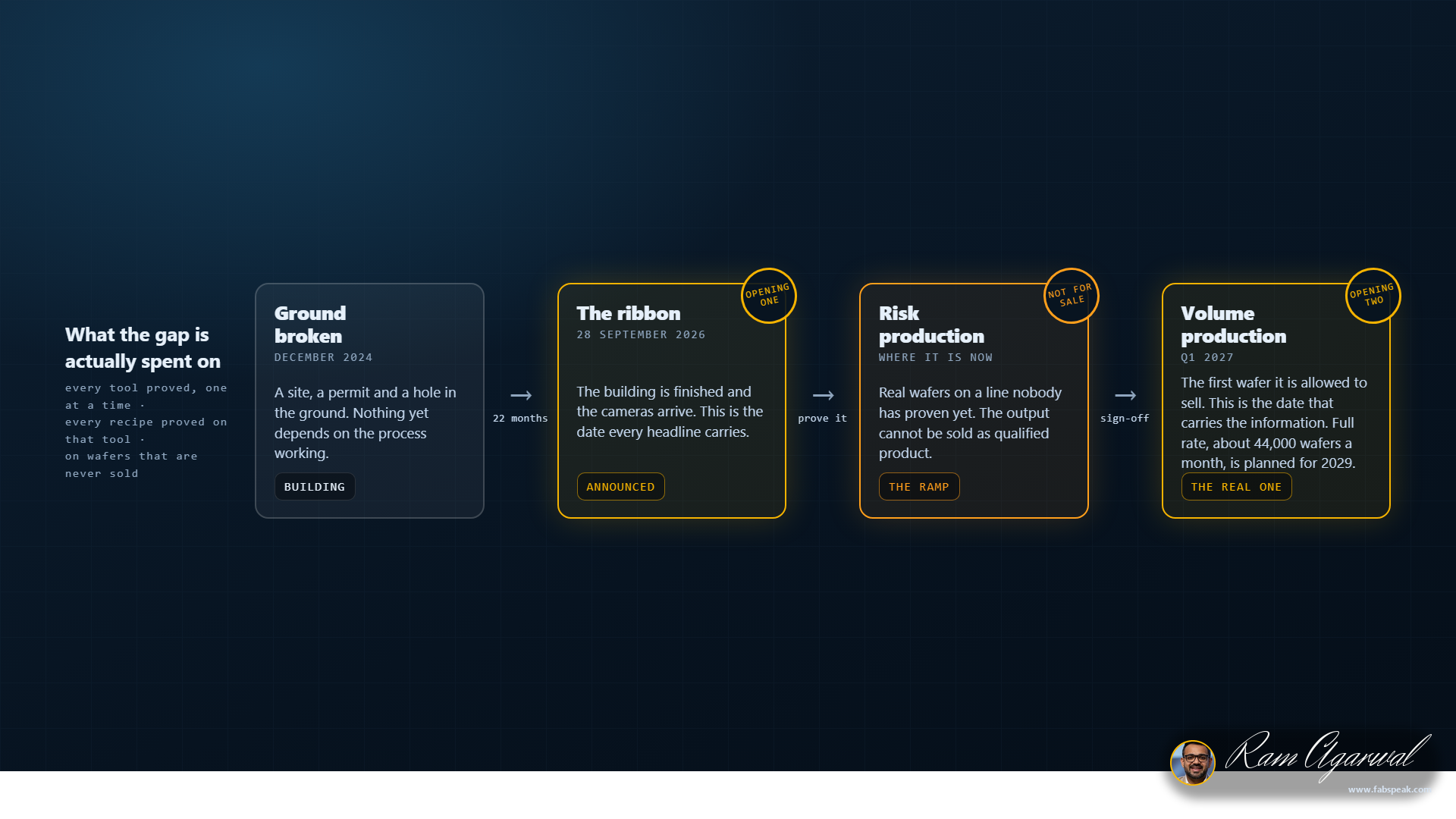
A chip factory opened in Singapore last week. Its whole first run is sold, and it still cannot sell it.
A factory like this opens twice. Once for the cameras, and once months later when it is allowed to sell what it makes.
The building took 22 months, from December 2024 to the opening on 28 September 2026. That part is fast.
What comes next is called the ramp: every machine proved one at a time, every recipe proved on that machine, on wafers that are never sold.
This factory already made good wafers in June, three months before the ribbon, at better than 99 in every 100 usable.
The date that carries the information is the first quarter of 2027, when it may finally sell. Full rate is planned for 2029.
Picture it. A restaurant can finish its building, hire its staff and take every booking for the next two years, and still not be allowed to serve a plate until the inspector has watched each dish being made and signed for it. The doors opening and the first bill are different days, and only one of them makes the local paper.
Why it matters to you. You can buy a building on a schedule. You cannot buy a ramp on a schedule, because a ramp is bought in practice wafers and in the records that prove each one.
Terms in this piece
- ramp yield ramp
- The stretch between a finished fab building and a wafer it is allowed to sell. Every tool is qualified one at a time and every recipe qualified on that tool, using wafers that are consumed by the proving and never sold.
- IT Information Technology
- The office computers and networks.
The number
TO BUILD IT, NXP, SEP 2026
What to do Monday
Mark every date as promised or measured. Next time an assistant drafts you a plan, a status update or a roadmap, give it one extra instruction: go through it and label each date either PROMISED (someone intends it) or MEASURED (it already happened, and here is the evidence). On the page the two look identical — same font, same confidence — and that is exactly why plans slip quietly. Most documents turn out to be almost entirely promises with two or three measurements buried in them, and seeing the ratio is usually the whole insight. Why it works: an assistant is good at classifying against a rule you supply and bad at inventing the rule. You are supplying the rule. The honest limit: it can only classify what the document says. If a date has no evidence attached, the assistant cannot tell you whether it is real — it can only tell you the evidence is missing, which is still worth knowing. And on long documents, ask it to output a table rather than eyeball the list, or it will quietly skip rows.
The honest caveat
Nothing here is a criticism of this factory or its owners. A 22-month build is fast, a first lot above 99% is good, and a fully booked first phase is a vote of confidence. The three-to-six-months-per-tool and six-to-twelve-months-to-high-volume figures are general industry commissioning guides, not this company's numbers: it has not published its own. Reported investment runs from $6.7 billion to $7.8 billion depending on the outlet, and the joint venture's own release gives no figure at all, which is why no single number is stated.
Your turn
When a new chip factory opens, what has actually been proven, and which date should you be reading instead?
Argue with me on LinkedInSources
- As citedNXP Semiconductors [primary]: "VSMC Celebrates the Grand Opening of Its First 300mm Fab in Singapore" — the 28 September 2026 opening, groundbreaking in December 2024, "22 months of construction", "risk production stage, with volume production scheduled to begin in the first quarter of 2027", "approximately 44,000 12-inch wafers per month" by 2029, "around 1,600 jobs", process technologies "ranging from 130nm to 40nm" — https://www.nxp.com/company/about-nxp/newsroom/NW-VSMC-V4 link
- PressTech Monitor [press]: "VSMC inaugurates first 300mm semiconductor fab in Singapore" — the first sample lot with "yields exceeding 99%", the Q1 2027 volume date, 44,000 wafers/month by 2029, ~1,600 jobs, and the statements from VIS chairman Leuh Fang and NXP CEO Rafael Sotomayor — https://www.techmonitor.ai/news/vsmc-inaugurates-first-300mm-semiconductor-fab-in-singapore link
- PressDIGITIMES (29 Sep 2026) [press]: "VSMC Singapore fab fully booked as VIS weighs Fab 2" — first-phase capacity fully booked under long-term contracts; a second Singapore fab under preliminary evaluation — https://www.digitimes.com/news/a20260929PD214/fab-vis-demand-capacity-12-inch.html link
- AnalystTechNode Global (28 Sep 2026) [press]: reports the plant at $7.8 billion; other outlets report $6.7 billion. The JV's own release gives no figure, which is why this video does not state one — https://technode.global/2026/09/28/taiwan-dutch-venture-vsmc-opens-7-8-billion-specialty-chip-fab-in-singapore/ link
- As citedEquipment commissioning guide [industry reference, NOT VSMC data]: install-to-volume-production for a major process tool at three to six months through IQ, OQ, PQ and Cpk sign-off, consuming 50–150 qualification wafers; risk production to high-volume manufacturing at six to twelve months — https://ai-mst.com/insight/en-equipment-commissioning-full-guide/ link
- AnalystSEMI (1 April 2026) [primary]: global 300mm fab equipment spending of $133 billion in 2026, up 18%, and $151 billion in 2027, up 14% — the scale of money now moving through exactly this phase of fab life. Quoted here for context; it is not this week's news — https://www.prnewswire.com/news-releases/semi-projects-double-digit-growth-in-global-300mm-fab-equipment-spending-for-2026-and-2027-302730416.html link
Read the full script (237 words)
Keep reading
All pieces
Everyone Is Announcing Capacity. Nobody Is Announcing The Number That Decides It.
Nobody is announcing yield — and only one of those decides whether the wafers are worth selling.
Your Chip Factory Can't Agree Which Die Failed
Every chip on a wafer has an address, and there is a standard for writing it down: SEMI E142, the specification for substrate mapping. The problem is that wafer test data mostly doesn't use it — the XY coordinates coming out of a prober depend on the prober and the recipe combination, and probably don't…

Chip Factories Everywhere. Nobody Left to Run Them.
America is building more chip factories than at any point in its history — and it has 33,000 fewer chip manufacturing workers than it did in 2023. That's not a forecast, it's the Bureau of Labor Statistics: 368,400 people this March, against a peak near 401,000.