
Is the AI Chip Bubble Bursting? Watch the Fab, Not the Ticker
A Chinese AI Just Wiped $1 Trillion Off Chip Stocks — Again. Here's the Truth.
In plain words
A Chinese AI wiped a trillion dollars off chip stocks. Watch the factory, not the ticker.
The stock market whipsawed three times in two weeks. A trillion-dollar selloff on 7 July was fully recovered by Friday.
That is a stock story. The factory story points the other way.
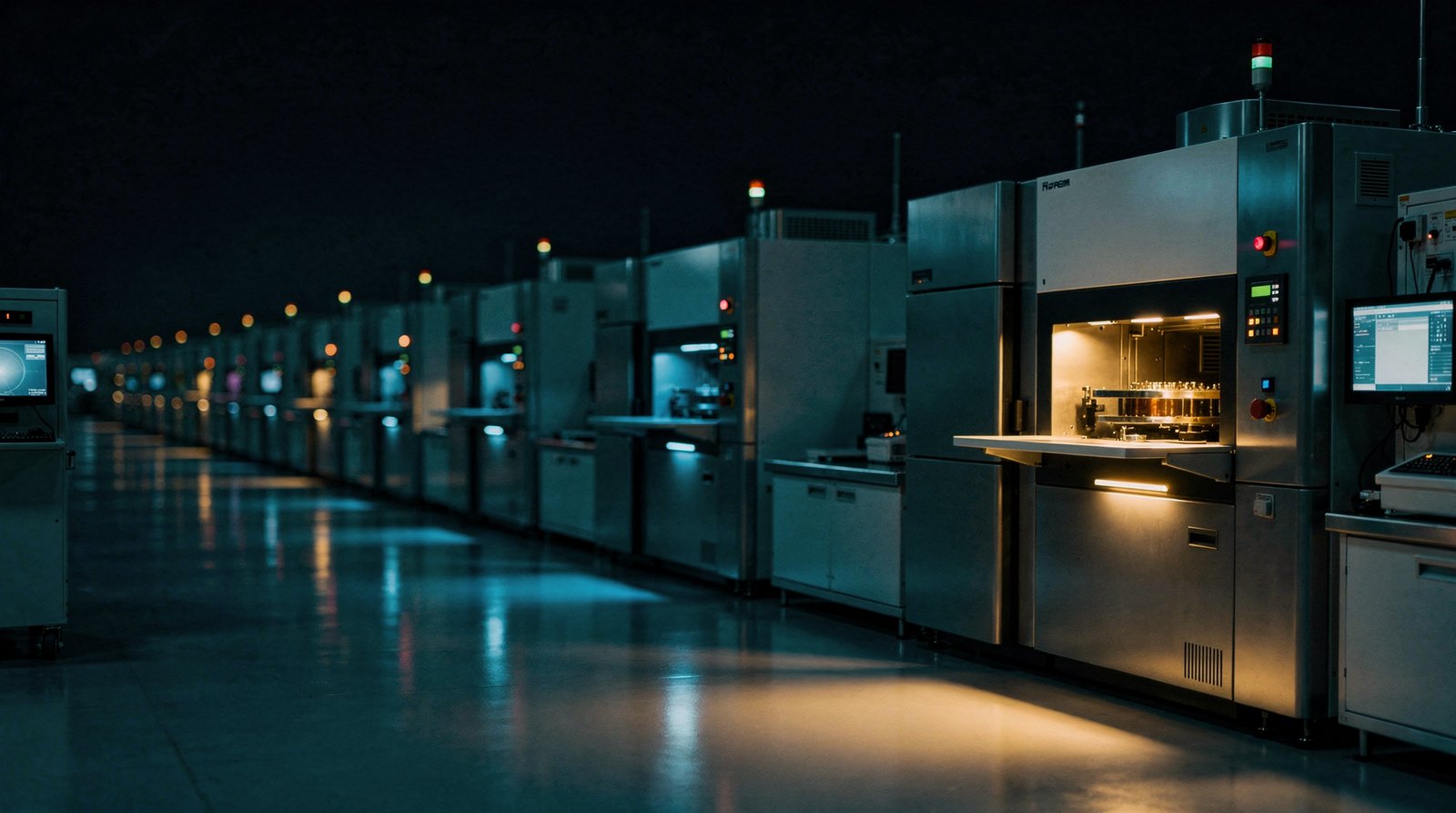
TSMC raised its spending plan. ASML raised its guidance twice. Packaging capacity is sold out through 2027.
Real demand does not move on a headline. It moves on equipment orders and factory utilisation.
Those numbers went up while the ticker went down.
Picture it. Watch what the builders are ordering, not what the estate agents are saying.
Why it matters to you. When the market panics about chips, look at what the factories are buying. Machines are ordered years ahead, and nobody orders them for a bubble.
Terms in this piece
- TSMC Taiwan Semiconductor Manufacturing Company
- The world's largest contract chip maker; it makes most advanced AI chips.
- ASML ASML, the lithography equipment maker
- The Dutch company that makes the machines that print chips, including every EUV machine.
- API Application Programming Interface
- The doorway one piece of software offers another, so they can exchange data or commands.
The number
ONE-DAY CHIP-STOCK SELLOFF · 7 JULY 2026
What to do Monday
Claude Code just added a built-in browser: in the desktop app, point it at a live page (your tool's API docs, a dashboard) and have it read and act on it — pull the exact settings or draft the integration script, no copy-paste.
The honest caveat
Equipment orders are placed years ahead, so they lag a real downturn and can look healthy for a while after demand turns. The factories may be right now and the market may still be right later. Watch both.
Your turn
Genuine question for the people who actually build this stuff: what's the ONE leading indicator you'd watch to call a real chip downturn — book-to-bill, tool loadings, capex guidance, or lead times?
Argue with me on LinkedInSources
The run's own source list was not recorded. These are the sources the piece names in its own words, listed here so every claim has an owner.
- PrimaryTSMC — raised its 2026 capital spending plan (company guidance, July 2026)
- PrimaryASML — raised its guidance twice in 2026 (company guidance, July 2026)
- PressAdvanced packaging capacity sold out through 2027, and the 7 July one-day selloff of about $1 trillion, market and industry reports as stated in the piece
Read the full script (300 words)
Keep reading
All pieces
A Record $403 Billion Quarter — And Nobody Made More Chips
On 6 August the Semiconductor Industry Association reported the biggest quarter the chip business has ever had: $403.3 billion in Q2 2026, up 35.1% on Q1, with June alone at $134.5 billion — 123.6% above June last year. The part that got almost no coverage is what did *not* happen.

The Most Important Monopoly in AI Just Cracked (It's Not Nvidia)
A $200B deal just cracked the most important monopoly in tech — and it's not Nvidia. It's the company that MAKES Nvidia's chips: TSMC, which quietly builds ~70% of the world's advanced AI silicon and, for years, had no real rival.

NVIDIA's Chip Is Finished — It Still Can't Ship (The Real AI Bottleneck)
NVIDIA's fastest AI chip has been finished for months — and it still can't ship. The reason isn't the 2-nanometer transistor everyone's racing toward; it's the very last step, advanced packaging.